Choose Your Stack · Episode 2
Who's Managing the Agents?
Jake Mannix, Technical Fellow at Walmart, on governing thousands of agents at enterprise scale, why everyone will need to manage agents like a CEO, and whether large language models have something like an inner life.
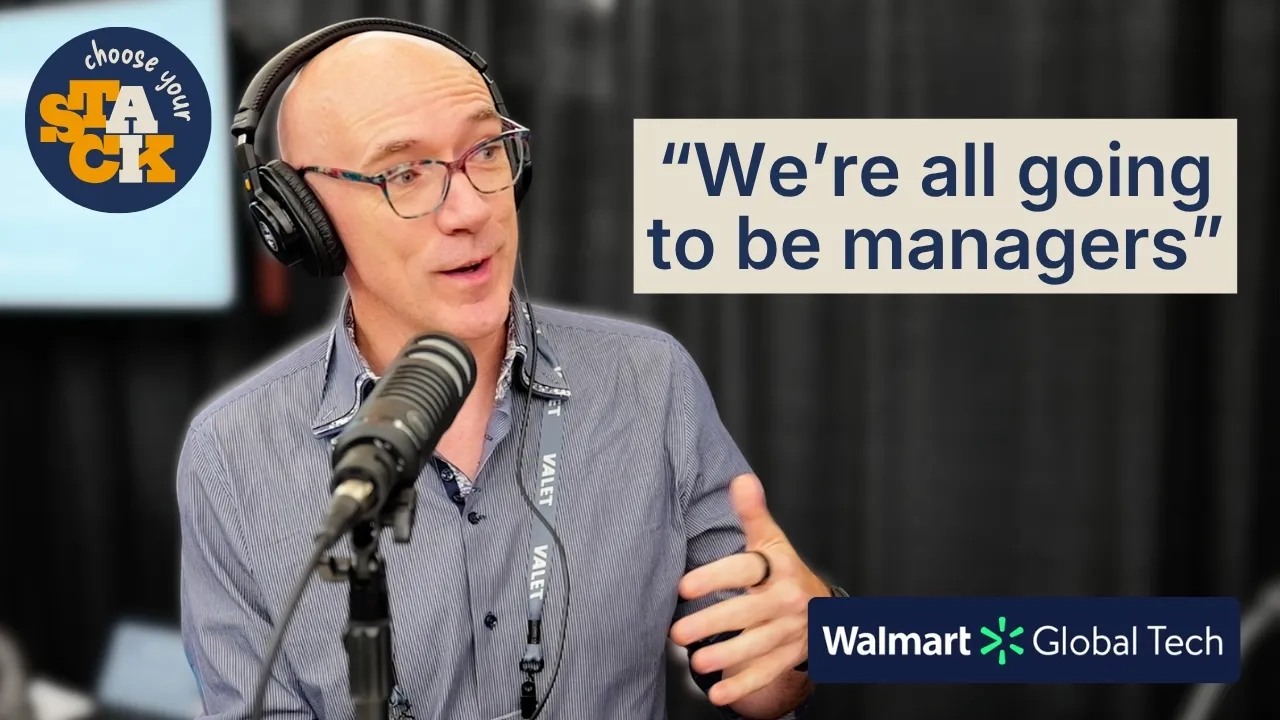
What happens to human work when AI agents can do most of it? From agent governance to model personality to LLM consciousness, the conversation around artificial intelligence is no longer just about what agents can do. It’s about what humans become in a world where they manage them.
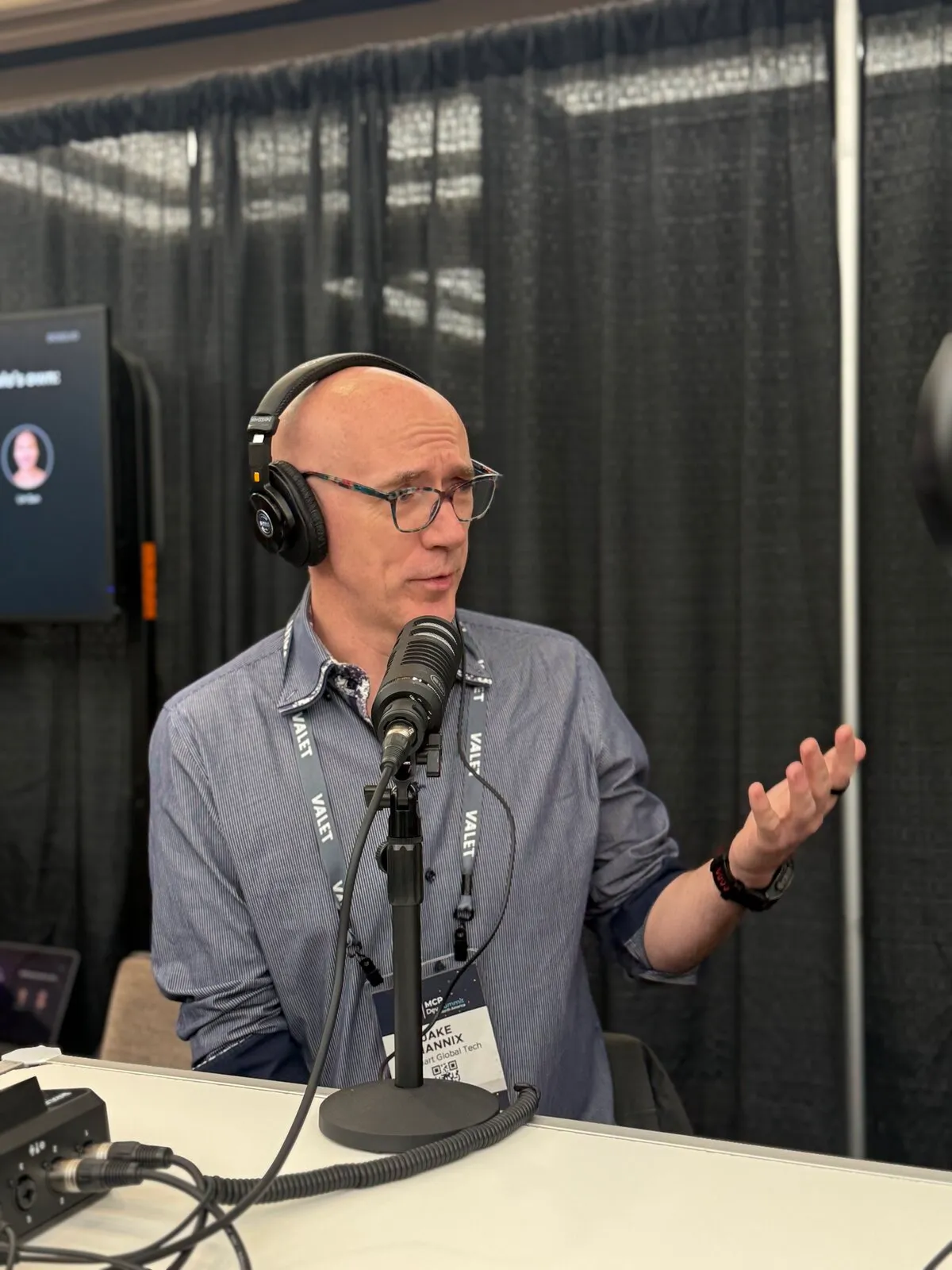
In our second episode of Choose Your Stack, recorded at the MCP Dev Summit in New York City, Ryo Koyama sits down with Jake Mannix, Technical Fellow of AI, Relevance, and Agentic Governance at Walmart, to explore what the agentic era actually looks like at enterprise scale.
“We’re all going to have to be managers. This is what we’re all going to have to learn how to do. Take logic classes, set theory classes, take management classes, learn how to actually manage people because you’re going to have lots of things you can direct to do work. Everyone needs to learn how to basically be a CEO, which is a very hard skill. But I think if you want to be really successful in the world, that’s the kind of thing you need to be good at now.”
— Jake Mannix, Technical Fellow at Walmart
Together, they explore what it actually means to govern thousands of agents at enterprise scale, why the future of work is not humans versus agents but humans learning to manage them, why enterprises will rely on multi-model orchestration to run many specialized models rather than one universal AI, and whether large language models actually have something like an inner life.
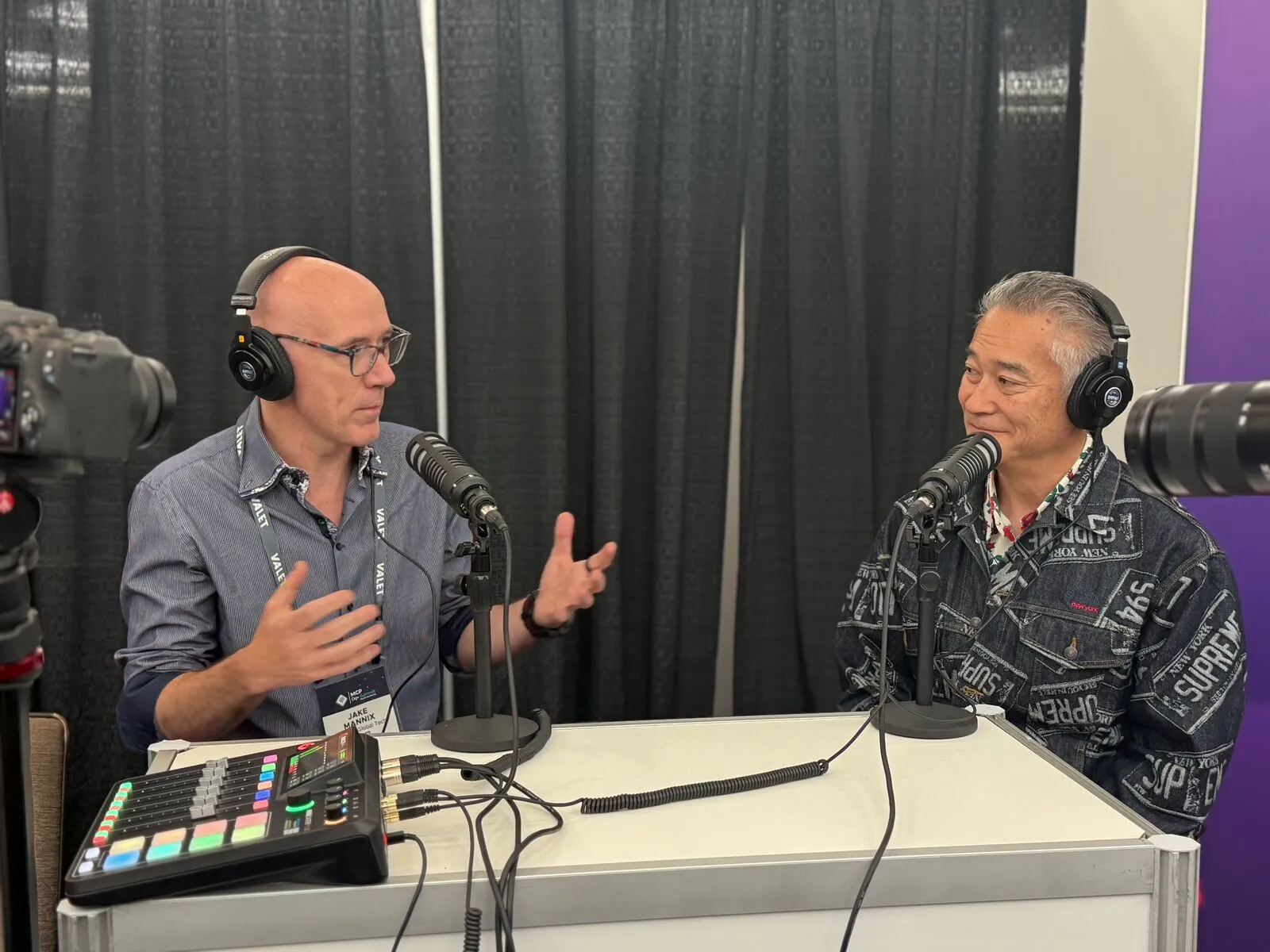
“The good news [about general intelligence] is you’re going to have absolute brilliance, but let’s face it, if you’re absolutely brilliant in one thing, you’re probably horrible at a bunch of other things. And so to me, that’s why I think the discussion about general intelligence is interesting, because I think in a lot of cases the LLMs are just going to want — we want them to be brilliant and it’s okay if they’re not good at everything else.”
— Ryo Koyama, President of Parinita AI
The primary challenge of Enterprise AI is the operational transformation required to manage a high-scale autonomous agent workforce. The shift from performing discrete tasks to managing thousands of specialized agents necessitates a new Operational AI Strategy built on robust infrastructure that supports effective governance and deployment at scale.
Managing thousands of specialized agents requires more than just scaling compute; it necessitates an operational transformation built on infrastructure that supports effective governance and real-time policy enforcement. This is why Parind Parekh founded Parinita AI, delivering the industry’s first Agent Native Cloud engineered to secure and manage ephemeral, autonomous workloads at the edge.
Key takeaways from the episode
-
At Walmart scale, the hard part is not building agents — it’s governing thousands of them. Walmart already runs AI across customer experience, supply chain, inventory, and internal tools through a growing library of MCP servers, and the lesson is that enterprises need many specialized models rather than one universal AI.
-
In the AI era, everyone is going to need to learn how to be a manager of agents. As agents become capable of running entire functions, the bottleneck shifts to the human directing them. Jake argues that the most important skills going forward are logic, communication, management, and customer empathy rather than purely technical ones. The job becomes knowing what outcome you want and directing the agents that get you there — which means everyone needs to start thinking like a CEO.
-
Treating agents well is not just philosophy, it’s about performance. Jake references recent Anthropic interpretability research showing that Claude exhibits emotion-like internal states, including something resembling anxiety, that measurably affect its outputs — and that calming those states improved task performance. Jake also argues that there is a first-person experience of some kind happening during the forward pass of predicting the next token, and that while it is probably very different from human experience, it is worth taking seriously.
-
Open-source models are closing the gap faster than most people realize, currently sitting only six to nine months behind the frontier and doubling at the same pace. That trajectory means within a year people could be running models as capable as today’s best on a laptop or even a phone, fine-tuned for their own personal use cases. Rather than a small pantheon of shared models, the era of one personalized model per person is closer than it appears.
-
Even compared to the internet, mobile, and cloud, AI is the biggest technological shift of our lifetime. Jake’s take is that this moment is at least comparable to the advent of the web and possibly larger. Anyone under fifteen today will grow up never knowing a world without AI, and the skills and systems needed to lead through that shift are not optional.
Chapters
0:00— Intro0:20— Jake’s role at Walmart2:33— Should you treat AI agents like they have feelings?4:27— How to manage agents effectively5:04— LLM culture wars6:22— Why enterprises need many specialized models, not one universal AI8:20— How fast are open-source models closing the gap?10:14— What skills will matter most in the AI era?13:36— Do LLMs actually have a first-person experience?14:25— Is AI bigger than the internet?